Ukraine Sanctions Russian Election Organizers, Keeping Geopolitical Risk in Focus
Kyiv targeted 44 people tied to Russian parliamentary voting in occupied Ukrainian regions, reinforcing a sanctions theme watched by global markets.
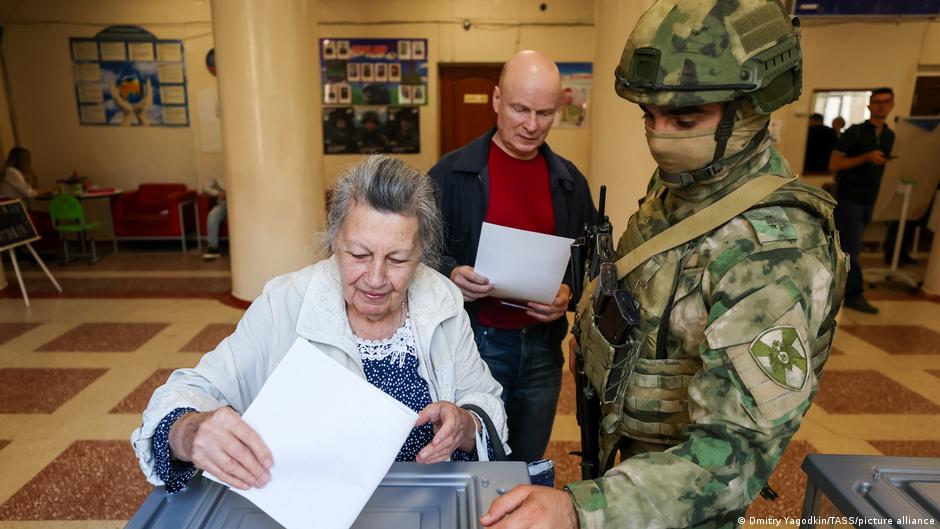
Ukrainian President Volodymyr Zelensky has imposed sanctions on people involved in organizing elections to Russia's State Duma in occupied Ukrainian territories, a move that keeps sanctions risk and the geopolitical backdrop firmly on the radar for Wall Street investors.
The restrictions target 44 people, according to the Ukrainian president's office. Of those, 38 hold both Ukrainian and Russian citizenship. The office said some of the sanctioned individuals had already been “elected” as so-called deputies of illegally formed local councils in temporarily occupied Ukrainian territory.
The decision, announced on Saturday, September 27, follows Russia's parliamentary elections held from September 18 to 20. For the first time in parliamentary elections, Russian authorities organized voting in occupied parts of Ukraine's Kherson, Zaporizhzhia, Donetsk and Luhansk regions.
Ukraine and Kyiv's Western allies have declared both the process and the results illegal. The European Union has also said it is ready to impose sanctions on people who helped conduct the voting in occupied Ukrainian territories.
Ukraine and Western allied countries recognized the process and its results as illegal.
Why Markets Are Watching
For equity investors, the immediate relevance is not a single earnings line or company-specific announcement. It is the persistence of geopolitical pressure around Russia's war in Ukraine and the continuing expansion of sanctions architecture. Sanctions regimes can affect sector sentiment, cross-border risk pricing, compliance costs and investor appetite for companies with exposure to sensitive jurisdictions.
Stock Press readers are likely to view the move through the lens of market positioning rather than diplomacy alone. Russia-related sanctions have remained a recurring consideration for energy, defense, banking, shipping, industrial and commodity-linked equities. While the source material does not identify publicly traded companies affected by Ukraine's latest measure, it adds to the policy backdrop that equity research desks typically monitor when assessing country risk, export controls, supply chains and regional revenue exposure.
The sanctions announcement may also reinforce a familiar pattern in sector rotation. Defense and security-linked names often attract attention when the conflict produces new political or military developments. Energy and commodity stocks can also move when investors reassess geopolitical risk, even if a specific announcement does not directly change supply volumes. Financial institutions and multinational companies with historical Russia or Eastern Europe exposure may face renewed scrutiny from compliance teams and analysts.
Trading volumes can be especially sensitive around sanctions headlines when investors are already positioned for macro catalysts, central-bank decisions or energy-price swings. The reported Ukrainian action does not include market data or trading figures, and no volume numbers were provided in the source. Still, sanctions developments are the kind of headline risk that can prompt portfolio managers to revisit exposure in sectors where policy risk is a material input.
Occupied Regions Added to Russia's Parliamentary Map
According to the source, Russian authorities created separate single-member districts for Ukrainian regions occupied after 2022 for the 2026 State Duma elections. Moscow then declared a number of candidates elected from those districts.
In the self-proclaimed “DNR,” Russia announced as elected Irina Kuksenkova, a war correspondent for Channel One, and Alexander Borodai, a former “head” of the self-proclaimed republic. In the self-proclaimed “LNR,” it named Denis Kolesnikov and Ivan Sanayev, described as deputies of a local parliament. In occupied parts of the Zaporizhzhia region, Russia declared Alexei Tikhomirov elected, and in Kherson, Elena Dmitruk, described as deputy chair of a local parliament. All of them ran on the United Russia ticket.
In addition to single-member district candidates, eight more representatives of the “authorities” in occupied Ukrainian territories entered Russia's State Duma through federal party lists. Among them was Serhiy Arbuzov, a former first deputy prime minister of Ukraine under President Viktor Yanukovych and former head of the National Bank of Ukraine, who was nominated by the A Just Russia party.
Equity Research Implications
For Wall Street research teams, the key question is whether the sanctions track expands beyond individuals into broader restrictions that affect investable sectors, counterparties or trade channels. The source article states that the European Union has expressed readiness to include people who facilitated the voting in sanctions lists. It does not state that the EU has imposed those specific measures yet, nor does it identify corporate targets.
That distinction matters. Individual sanctions can be significant politically and legally, but direct equity-market consequences generally depend on whether restrictions touch listed companies, banks, payment systems, insurers, commodity flows or major state-linked enterprises. In this case, the article identifies individuals and political structures tied to occupied territories rather than specific corporate entities.
Even so, investors may treat the development as another data point in a continuing sanctions cycle. Equity research covering European energy, defense procurement, regional banks, shipping logistics and emerging-market risk will likely continue to monitor whether Western governments translate political condemnation into enforceable restrictions with broader market reach.
The broader market message is one of continuity: the conflict remains a source of headline risk, legal uncertainty and regional risk premium. Ukraine's action against organizers of Russia's parliamentary voting in occupied territories, along with the European Union's stated readiness to respond, signals that sanctions policy remains active rather than static.
For traders, the practical takeaway is to watch the follow-through. Any subsequent EU listing decisions, changes in enforcement guidance or expansion from individuals to institutions would be more likely to influence specific stocks and sector baskets. Until then, the announcement reinforces existing geopolitical sensitivity across defense, energy, financials and companies with any residual Russia-linked exposure.