German Protests Put Political Risk Back on Watchlists for Europe Investors
Mass demonstrations against right-wing extremism add another political variable for investors tracking Germany’s equity market and policy outlook.
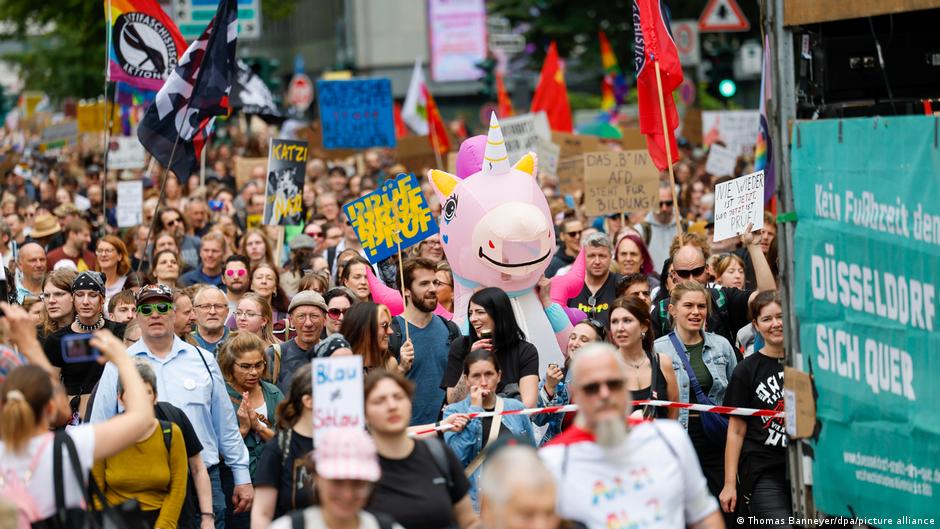
Mass demonstrations against right-wing extremism took place in more than 35 German cities on September 12, drawing tens of thousands of people into the streets and putting renewed attention on the country’s political backdrop at a sensitive moment for European markets.
The protests came one week after the far-right Alternative for Germany, or AfD, won a state election in Saxony-Anhalt. For Wall Street investors, the immediate read-through is less about a single trading catalyst and more about a broader political-risk premium around Germany, the eurozone’s largest economy and a core exposure for global equity portfolios.
Organizers estimated that 25,000 people attended the demonstration in Hamburg, while around 20,000 participated in Düsseldorf. Local police also confirmed the Düsseldorf figure. In Berlin, law enforcement estimated turnout at 18,000, and about 2,000 people protested in Mainz. In Munich, public broadcaster ARD estimated participation at 12,000.
The scale of the mobilization, spread across more than 35 cities and organized by more than 100 associations, gives equity strategists another signal to monitor as they assess Germany’s policy stability, coalition dynamics and investor sentiment toward European assets.
Political Risk Enters the Market Conversation
Germany’s listed companies remain tied to global demand, interest rates, energy costs and currency moves, but domestic political developments can still shape the discount investors apply to European equities. The weekend protests underscored the intensity of public debate around the AfD, whose electoral strength has become a more prominent issue for policymakers, institutional investors and research desks following German regional contests.
In Saxony-Anhalt’s capital, Magdeburg, about 1,100 people joined a protest. Saarbrücken drew 1,500 participants, while several hundred people protested in Erfurt. In Schwerin, the capital of Mecklenburg-Western Pomerania, where the AfD was also leading in polls one week before local elections, several dozen people took part.
For investors, those figures matter mainly because they point to the geographic breadth of political polarization rather than because they change earnings estimates directly. A stronger far-right vote in German state politics can complicate policy formation, sharpen debate over immigration and public spending, and influence how foreign investors view the predictability of Europe’s industrial center.
That is particularly relevant for sectors often used as proxies for Germany risk, including automakers, industrial manufacturers, chemicals, banks and utilities. Investors in U.S.-listed American depositary receipts and exchange-traded funds with German or broad eurozone exposure may watch whether political headlines contribute to sector rotation between defensive European names and more cyclical exporters.
“No step back! Against the AfD and right-wing agitation!”
That slogan was used at demonstrations in Düsseldorf. In Hamburg, protesters rallied under the slogan, “Time to act - freedom must be defended.”
AfD Ban Debate Draws Investor Attention
Several demonstrations, including those in Munich, Mainz, Saarbrücken and Magdeburg, were held as part of the Prüf campaign. The campaign calls for a thorough review of parties classified by Germany’s Federal Office for the Protection of the Constitution, or BfV, as suspected of right-wing extremism or definitively right-wing extremist.
The German word Prüf means “check.” Organizers also present it as an acronym for “Prüfung Rettet Übrigens Freiheit,” meaning “Review, by the way, saves freedom.”
At the rallies, demonstrators called for the launch of a procedure to ban the AfD. In May 2025, the BfV classified the AfD as right-wing extremist at the federal level, although that classification is not currently in effect because of a lawsuit filed by the party.
That legal and institutional process is the type of uncertainty equity research teams may track even when it does not produce an immediate move in stock prices. A potential party-ban procedure, litigation over the BfV classification, and public disagreement over how mainstream parties should deal with the AfD all feed into the political assumptions behind country-risk analysis.
An INSA opinion poll conducted on September 10 and 11 found that 42% of respondents supported the idea of banning the AfD, while 45% opposed it. The same poll found that 46% of Germans opposed the “firewall” policy toward the AfD, under which other parties refuse to cooperate with it. Support for maintaining that barrier stood at 34%, while 20% were undecided.
For Wall Street, the key takeaway is that Germany’s political divide remains measurable and unresolved. The poll numbers show no consensus on either a ban or the firewall strategy, suggesting that political uncertainty could remain a recurring market narrative rather than a one-day headline.
Trading desks are likely to treat the protests as part of a broader European political-risk mosaic rather than as a standalone event. Still, the combination of large demonstrations, a recent AfD state-election victory, pending local elections in Mecklenburg-Western Pomerania, and legal disputes over extremism classification gives investors fresh reason to scrutinize German exposure inside regional equity allocations.
Absent company-specific guidance or reported trading-volume data in the source material, the market impact is best understood as a sentiment and risk-assessment issue. Equity research coverage may focus on whether political fragmentation affects fiscal planning, regulatory priorities or the investment climate for Germany’s export-heavy corporate sector.