Trump Threatens EU Trade Halt Over Canada Ties, Raising Tariff Risk
The U.S. president warned that deeper EU-Canada cooperation could trigger steep duties or a broader break in transatlantic trade.
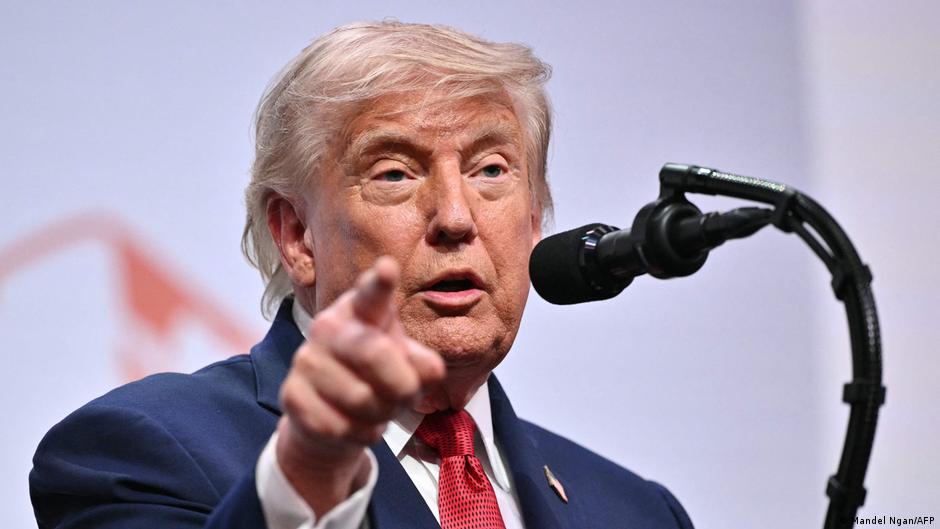
U.S. President Donald Trump threatened to halt trade with the European Union if the bloc moves ahead with plans to deepen its partnership with Canada, a warning that adds another layer of tariff risk for investors already navigating a volatile global trade backdrop.
Speaking on Wednesday, September 16, at a campaign event in North Carolina, Trump responded to a reporter’s question about European Commission President Ursula von der Leyen’s plan to make Canada the EU’s “first associate member.” He called the proposal “ridiculous” and said he could impose very high tariffs or stop trade with Europe if he judged the move to be hostile to U.S. interests.
“If they do this and I consider it, even in the slightest degree, an unfriendly act, I will impose very high tariffs or stop trade with Europe,” Trump said.
The comments put renewed focus on stocks tied to cross-border supply chains, European exporters, Canadian industrials and U.S. companies with significant EU revenue exposure. For Wall Street, the immediate issue is not only the legal or diplomatic meaning of any potential EU-Canada associate status, which remains undefined, but the market risk that trade policy could again become a driver of sector rotation and valuation pressure.
Tariff Risk Returns to the Equity Screen
Trump said the U.S. response would depend on the intent behind the EU-Canada initiative. “If the intentions are good, everything is fine. If the intentions are bad, we will impose very high tariffs on Europe, that is one of the possibilities,” he added.
Von der Leyen, speaking in the European Parliament on September 16 in the presence of Canadian Prime Minister Mark Carney, said the European Union wanted to take relations with Canada to “the highest possible level.” She said she and Carney wanted to work toward making Canada the bloc’s first associate member.
She did not provide details on what such a partnership would contain. However, she cited cooperation in technology and the defense industry, two areas that equity investors tend to treat as strategically sensitive and politically exposed. Von der Leyen also emphasized that joint EU-Canada work “will not be directed against others” and would be aimed at making both sides stronger.
The remarks matter for markets because trade measures tend to affect sectors unevenly. Autos, industrial machinery, metals, aerospace, defense suppliers, logistics companies and consumer goods manufacturers are typically among the first groups investors reassess when tariff threats escalate. Technology stocks may also face scrutiny if policy uncertainty begins to affect procurement, data infrastructure, semiconductor supply chains or government-backed industrial initiatives.
In the U.S. market, traders are likely to watch companies with large European sales bases and those dependent on imported inputs. In Europe, exporters with U.S. exposure could face renewed pressure if investors begin pricing in higher duties. In Canada, the proposed EU alignment could be viewed as a strategic offset to U.S. trade unpredictability, but it also risks drawing Canadian equities further into Washington’s tariff calculus.
Canada Measures Add to Trade Tensions
The White House said Trump on September 16 signed a memorandum banning Canadian goods from participating in U.S. federal government procurement. According to the press release, Washington is taking the measures in response to Canada, which it said had “unreasonably introduced new barriers” for American companies seeking access to the public procurement market.
The procurement restrictions come alongside new tariff actions. From September 15, the U.S. administration introduced additional 50% duties on Canadian cheeses, steel, aluminum, paper, furniture, lighting fixtures and other goods. Trump administration officials said the move was a direct response to Ottawa’s new tariffs.
Canada’s tariffs on approximately $20 billion of U.S. exports also came into force on September 15. Those measures were a response to U.S. tariffs of 50% on $20 billion worth of Canadian goods that took effect on August 22. Canada withdrew from trade negotiations with the United States on August 21.
For equity research desks, the immediate task is to distinguish headline sensitivity from earnings sensitivity. The clearest pressure points are companies with direct tariff exposure in metals, furniture, paper, lighting, cheese and related distribution channels. Broader index-level effects would depend on whether the dispute remains targeted or expands into a wider interruption of trade between the United States and Europe.
Trading volumes could rise in exchange-traded funds tracking European equities, Canadian equities, industrials, materials and defense. Currency-sensitive sectors may also come into focus if trade tensions alter expectations for growth, inflation or central-bank policy. Any sharp shift in the dollar, euro or Canadian dollar would feed into earnings translation assumptions for multinationals.
AFP noted that Canada, like the EU, has been affected by Trump’s unpredictable trade and foreign policy, and that this is why both Canada and the European Union are looking at new alliances. That strategic logic may support defense and technology cooperation over time, but in the near term it leaves investors facing a familiar question: whether political diversification away from U.S. pressure will itself provoke a stronger U.S. trade response.
The market impact will depend on follow-through. A rhetorical threat may produce short-term volatility and selective derating in exposed names. A formal tariff package or trade halt would have much broader implications for supply chains, input costs and corporate guidance. Until more details emerge from Brussels, Ottawa and Washington, investors are likely to treat the EU-Canada proposal as a new geopolitical input in earnings models rather than a fully defined policy framework.