Khodorkovsky Urges Europe to Split Russian Elite, Raising Risk Focus
The opposition figure’s proposals put sanctions, political transition and Russia-linked equity risk back in focus for global investors.
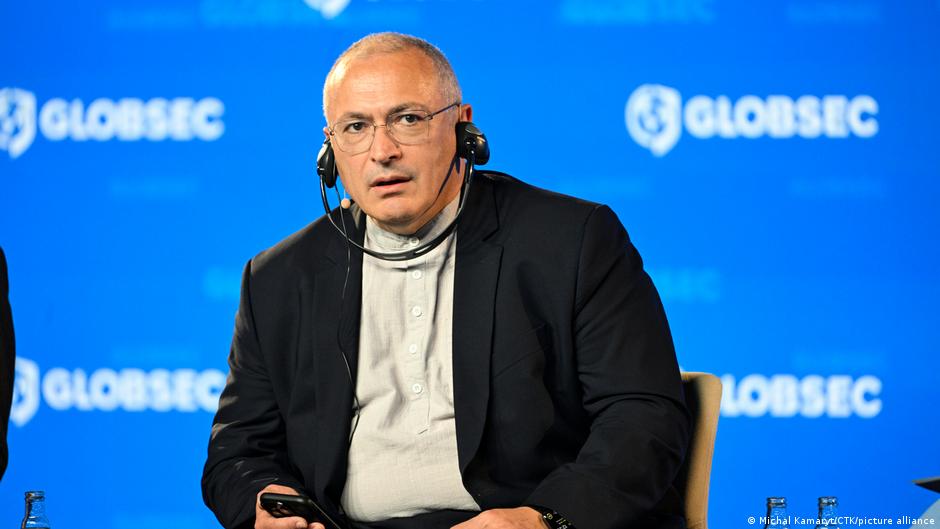
European governments should offer influential members of Russia’s elite a credible alternative to supporting President Vladimir Putin, opposition figure Mikhail Khodorkovsky said, outlining a strategy that could affect how investors assess sanctions, political-transition risk and exposure to Russia-linked businesses.
Speaking Tuesday, Nov. 3, at a Russian Anti-War Committee conference in Brussels, Khodorkovsky argued that powerful Russians continue to support Putin partly because they are unconvinced that their position would improve under a different government. He also pointed to the personal-security system constructed by the Russian president as an obstacle to any effort by domestic actors to remove him.
“If we are talking about a split among the elites, then we need to demonstrate opportunities for a personal exit,” Khodorkovsky said.
He acknowledged that such an exit could still entail losses for those involved. Khodorkovsky did not specify its terms at the conference, but he has previously written that a declaration of disagreement would be insufficient for people who had cooperated with the regime. He cited donations to Ukraine and testimony to investigators about alleged regime crimes as possible examples of meaningful action.
Sanctions and transition risk remain central
For Wall Street, the comments are most relevant as a framework for evaluating geopolitical risk rather than as a direct trading catalyst. The speech named no publicly traded companies, offered no sector-specific forecasts and provided no figures on trading volumes. It nevertheless highlighted variables that can influence valuations across European banks, energy producers, defense companies and other businesses exposed to sanctions, cross-border payments, Russian commodities or the war in Ukraine.
Khodorkovsky called Europe’s failure to create pathways for elite defections by the fifth year of the war a serious mistake. Any European policy that distinguished between individuals willing to break with the Kremlin and those continuing to support it could potentially alter sanctions expectations. However, he offered no detailed policy proposal, timetable or indication that European governments were preparing such changes.
Equity research teams tracking Russia-related risk would therefore need to separate the political argument from actionable policy. The immediate market significance depends on whether European authorities translate such proposals into sanctions relief, exemptions or new conditions for individuals and businesses. None of those measures was announced at the conference.
Khodorkovsky warns against a violent reckoning
In his opening address, Khodorkovsky also warned that efforts to prosecute people connected to the war or restrict their rights could provoke armed resistance inside Russia. He said millions of Russians were tied to the conflict because they or their relatives had fought, worked at military enterprises or supported the political order established by the authorities.
Some of those people, he said, are accustomed to carrying weapons and could resist measures such as lustration, reparations or prosecutions. “We must understand that when we speak about lustration, contributions and trials of war criminals, we are speaking about a new war,” he said.
That warning adds a downside scenario to investor assessments of any eventual political transition. A disorderly transfer of power could intensify uncertainty surrounding commodity exports, corporate ownership, sanctions enforcement and contractual obligations. Khodorkovsky contrasted forced transformation with national reconciliation and gradual democratization, arguing that internal armed conflict would produce another authoritarian system and postpone democratic change for another political generation.
He issued a similar warning about the possible breakup of the Russian Federation, saying such an outcome would be paid for in blood. He urged policymakers to debate not only the result they want but also the means used to achieve it.
Institutional change as de-escalation
Khodorkovsky proposed focusing on what he called “institutional de-escalation,” meaning changes to Russia’s system of government intended to reduce the threat of war. In his view, even a shift from one-person rule to collective leadership could lower the probability of conflict. A parliamentary model and greater federalization would reduce that probability further, he said.
From a sector-rotation perspective, the remarks reinforce the distinction between conflict-sensitive groups and companies with limited regional exposure. Defense, energy, banking and commodity-linked shares may remain more responsive to changes in war expectations, sanctions or Russian political stability than domestically focused sectors. The conference itself, however, supplied no trading data or equity-research recommendations and did not establish a near-term catalyst for any specific stock.
The Russian Anti-War Committee’s two-day conference is being held in Brussels on Nov. 3-4 and is devoted to scenarios for ending Russia’s war against Ukraine. Its program also includes discussions of sanctions, nuclear risks and the possibility of putting Putin on trial.