Bosnia Vote Extends Dodik Allies’ Grip, Offering Limited Wall Street Catalyst
Preliminary results showed ruling-party candidates prevailing across Bosnia and Herzegovina, with investors likely to treat the outcome as a regional political-risk marker.
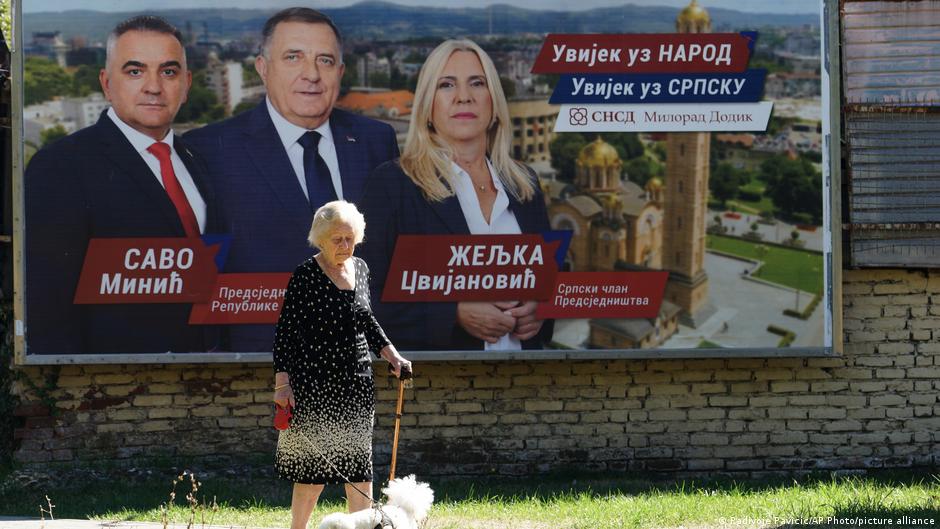
Preliminary election results in Bosnia and Herzegovina pointed to a broadly status-quo outcome, with ruling-party candidates and allies of Milorad Dodik prevailing in key contests, including the presidency of Republika Srpska. For Wall Street, the vote is unlikely to produce an immediate single-stock catalyst, but it reinforces a political-risk backdrop that global investors track when assessing southeastern Europe, European Union enlargement dynamics, and exposure to countries near the fault line between Brussels, Moscow and local nationalist politics.
Savo Minic, the prime minister of Republika Srpska, won the election for president of the region, according to preliminary results. Minic was backed by Dodik, the former president of Republika Srpska, who is known for his closeness to Russia. A Dodik ally, Zeljka Cvijanovic, also remained on course to represent Serbs in Bosnia and Herzegovina’s tripartite presidency.
The elections covered members of the state presidency, the central parliament, two regional parliaments and the president of Republika Srpska. They produced few surprises. Preliminary results published by the Central Election Commission on the evening of Sunday, October 4, showed candidates from ruling parties ahead in the main races.
Investors See Continuity, Not a Fresh Trading Shock
For U.S. equity investors, the first read is continuity. Bosnia and Herzegovina is not a major direct driver of Wall Street earnings, trading volumes or index-level performance. The country does not typically move U.S. large-cap benchmarks, and the election result does not create an obvious immediate read-through for major U.S.-listed companies. The more relevant market lens is regional stability: banks, insurers, infrastructure investors, energy groups and funds with exposure to the Balkans and broader emerging Europe tend to treat such elections as part of a wider sovereign and geopolitical-risk mosaic.
That makes the vote more important for sector rotation within Europe-facing and emerging-market allocations than for a direct S&P 500 move. A result that keeps Dodik’s political network influential may keep attention on constitutional tensions, relations with international institutions, and Bosnia’s ability to function under a complex postwar governance structure. In equity research terms, the event is less a trigger for immediate revisions and more a factor in country-risk premiums, portfolio positioning, and investor appetite for peripheral European exposure.
After 95% of ballots were counted, Denis Becirovic remained the leading candidate to represent Bosnian Muslims in the presidency. Becirovic had previously served as chairman of the presidency and received about 38% of the vote. Croats were preliminarily set to be represented by Darijana Filipovic, who had about 48% of the vote. Serbs favored Cvijanovic, who had about 55% and had also previously served in the presidency.
Preliminary results published by the Central Election Commission showed candidates from ruling parties ahead, leaving little sign of an electoral upset.
Bosnia and Herzegovina has a unique presidency in which representatives of Croats, Bosnian Muslims and Serbs jointly perform the duties of head of state. The arrangement was created under the 1995 Dayton Accords, which were designed to resolve disputes among Bosnian Muslims, Orthodox Serbs and Catholic Croats and brought an end to the civil war. Many analysts regard the system that emerged from the accords as inefficient.
Republika Srpska Remains the Core Risk Focus
The main uncertainty in the vote centered on the presidency of Republika Srpska, the Serb-majority entity within Bosnia and Herzegovina. The contest there featured opposition candidate Branko Blanusa against Minic, the region’s prime minister. Preliminary results showed Minic winning. He led Blanusa in most electoral districts in Republika Srpska. The opposition candidate carried some districts, but the Central Election Commission’s data indicated that those wins did not change the overall result.
Minic and Cvijanovic both ran for the Alliance of Independent Social Democrats, or SNSD, the party founded by Dodik, who previously served as president of Republika Srpska. In 2025, Dodik was forcibly removed from office for failing to comply with decisions of Bosnia and Herzegovina’s Constitutional Court and with international agreements.
According to the Central Election Commission, the SNSD was also winning elections to the parliament of Republika Srpska, the National Assembly. Most Bosnian Serbs also voted for the same party in elections to the lower house of the country’s parliament, the House of Representatives of the Parliamentary Assembly.
Dodik has already congratulated both Minic and Cvijanovic on their victories. Under a court decision, Dodik himself is barred from political activity for six years. He has refused to recognize the court’s ruling and traveled to Moscow to seek support. Dodik and Minic met with Vladimir Putin in the Kremlin on September 29.
That Russia connection is the part of the story most likely to matter to global investors. It does not automatically translate into a trade in U.S. equities, but it may shape how research desks discuss Balkan risk, European political cohesion and the resilience of postwar institutions. In a market already sensitive to geopolitical fragmentation, the Bosnia result adds one more data point for analysts monitoring Europe’s periphery.
Trading desks are therefore likely to treat the result as a contained political development rather than a broad market event. Any impact would be expected to show up more through sentiment toward regional assets, sovereign-risk analysis and emerging-Europe funds than through high-volume moves in U.S. sectors. For Wall Street, the election matters less because of Bosnia’s size and more because it confirms the durability of a political bloc aligned with Dodik at a time when relations with courts, international agreements and Moscow remain central to the country’s risk profile.