Uzbek ID-Card Fee Debate Flags Frontier-Market Digital Access Pressure
A social-media outcry over first-time ID-card costs in Uzbekistan is highlighting affordability risks in digital public infrastructure across Central Asia.
For Wall Street readers, the debate now raging in Uzbekistan over the cost of a first national ID card is less a direct single-stock catalyst than a policy signal from a frontier market trying to digitize civic identity while keeping basic access affordable. The issue erupted after a journalist described a father and his teenage daughter at a local passport office, where the family appeared to struggle to cover the state fee required for the girl's first identity document. The episode has since focused attention on how Uzbekistan prices entry into its formal identification system and how that compares with nearby countries.
The discussion accelerated after journalist Dilnoza Qurbonova wrote about seeing a 15- or 16-year-old girl standing beside her parents as they tried to obtain her first ID card. Qurbonova said the parents' worn clothing and expressions suggested economic hardship. When staff announced the amount due at the cashier, the father's hands began to shake and he opened his wallet to count the money inside, one piece at a time. She wrote that the girl first looked at her father and then down at the ground, turning an administrative payment into a public argument over fairness, dignity and the price of legal identity.
He opened his wallet and began counting even the last small coins one by one.
In market terms, the report does not identify any listed company, procurement change or financing transaction, so it offers little basis for an immediate call on specific stocks, trading volumes or sector rotation. Its importance lies elsewhere. A first identity document is the gateway to state services, compliance and wider participation in the formal economy. When that gateway is expensive, investors who track digital public infrastructure, e-government execution and social policy in emerging and frontier markets tend to read it as a friction point that can slow adoption and raise political sensitivity.
Fee structure is tied to Uzbekistan's base calculation unit
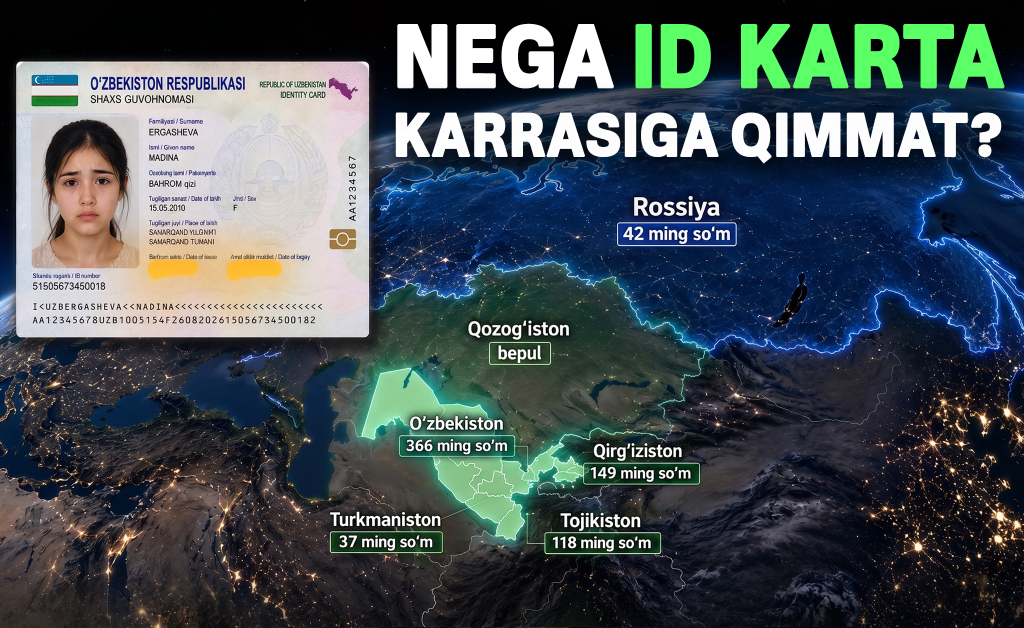
Uzbekistan charges different amounts for a first ID card depending on how the application is filed. If the application is submitted through a migration office, a public services center or a consulate, the state fee is set at 89% of the base calculation unit, or BHM. With the BHM currently at 412,000 so'm, that produces a fee of 366,680 so'm. If the application is submitted online through my.gov.uz, the charge is set at 80.1% of the BHM, which currently equals 330,012 so'm. Because the pricing is tied directly to the BHM, the cost of basic identity access rises automatically when the benchmark rises, unless the fee formula itself is changed.
That linkage matters now because the BHM has been fixed at 412,000 so'm since August 1, 2025, but is scheduled to increase to 440,000 so'm on September 1, 2026. If the fee rates remain unchanged, the in-person or consular charge for a first ID card will rise to 391,600 so'm, while the online fee will increase to 352,440 so'm. For investors, that does not translate into an immediate earnings event, but it does show how administrative pricing in digital identity can become more restrictive at the same moment governments are trying to broaden formal onboarding.
Regional comparison points to lower-cost entry in many markets
The comparative picture is what has pushed the issue higher on the agenda. The review spans eight states when Uzbekistan is included. In Kazakhstan, every citizen turning 16 has been able to obtain an ID card for the first time free of charge since January 1, 2026, and renewal after expiration is also free. The waiver also applies in cases where citizens receive the document for the first time after age 18, acquire Kazakh citizenship, or fall into certain other categories. The initiative is intended to reduce citizens' financial burden and simplify document processing.
In Kyrgyzstan, first-time applicants can obtain an ID card under the standard procedure within 12 working days for 1,103 Kyrgyz som, equal at the current rate to about $12.6 or 149,000 Uzbek so'm. That makes the standard first-time cost roughly 2.5 times cheaper than Uzbekistan's current 366,680 so'm state fee. In Tajikistan, the fee for an ID card is set at $10, collected in somoni at the exchange rate on the day of payment, with processing taking up to 15 days. Based on the Central Bank of Uzbekistan's official rate on August 21, that is about 118,000 Uzbek so'm, or roughly 3.1 times cheaper than the Uzbek fee now in force.
Turkmenistan uses a different structure because it does not have a separate national ID card; the main identity document is a biometric passport. According to the State Migration Service, the state fee for that passport is 60 manat, equal at the black-market rate to about $3.2 or 37,000 Uzbek so'm, and children under 16 are exempt. That is about 10 times cheaper than the Uzbek charge cited in the debate. In Russia, citizens receive an internal passport at age 14, and the state fee for first issuance is 300 rubles, or about $3.6 and 42,000 Uzbek so'm at the current rate. That is roughly 8.7 times cheaper than the Uzbek first ID-card fee. Russia's Tax Code applies the same 300-ruble duty to first issuance and routine replacement, while a lost or damaged passport costs 1,500 rubles.
Turkey's main identity document, the Türkiye Cumhuriyeti Kimlik Kartı, is priced at 220 Turkish lira in 2026, or about $5 and 59,000 Uzbek so'm. But if a child's birth is registered within the legally required period and the first identity card is issued accordingly, no fee is charged. A card issued after the deadline or as a replacement costs 220 lira. In Azerbaijan, citizens receive an identity card from age 15, and the Interior Ministry says the standard 10-day issuance fee is 5 manat. Taken together, the comparison suggests Uzbekistan's first-document charge sits at the expensive end of the regional range, especially for low-income households. In equity-research terms, that makes the issue a governance and adoption signal for digital public infrastructure rather than an immediate market-moving event, but one that frontier-market investors will still watch closely.