Putin Nuclear Warning Puts Defense and Energy Risk Back on Wall Street
The Russian president’s Valdai remarks renewed geopolitical risk for investors tracking defense, energy, AI and Europe-exposed equities.
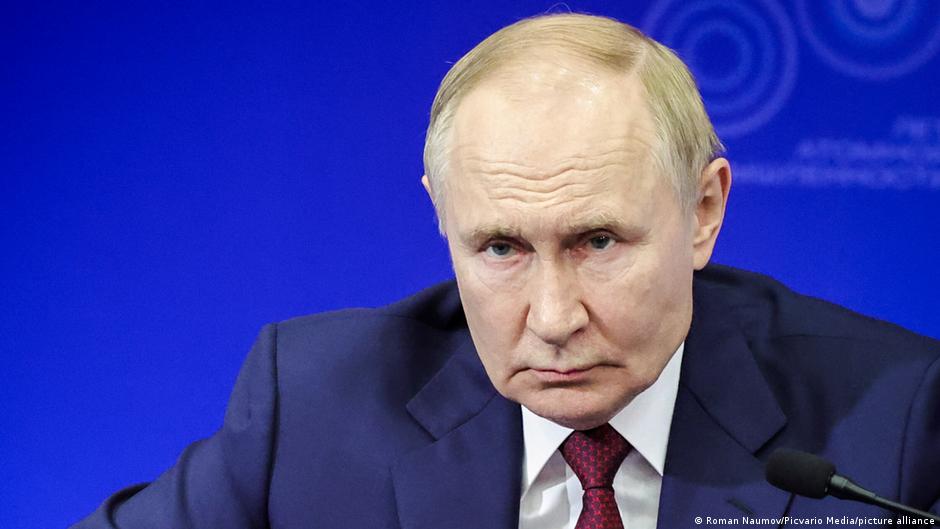
Russian President Vladimir Putin used a closely watched foreign policy forum to accuse the West of responsibility for the war in Ukraine and to revive nuclear warnings that could keep geopolitical risk near the top of Wall Street’s trading agenda.
Speaking at a plenary session of the Valdai Discussion Club on Thursday evening, October 1, Putin described the situation in Europe and the wider world as “very dangerous” and again alleged that Western countries were pursuing aggression against Moscow. The session was held this year in the Moscow region rather than Sochi, a shift linked in the source article to security concerns after intensified Ukrainian attacks and to the greater concentration of Russian air-defense assets near Moscow.
For equity markets, the remarks landed in familiar but still consequential territory: a fresh reminder that the war in Ukraine remains a potential catalyst for sector rotation, headline-driven volatility and renewed demand for hedges tied to defense, energy and European risk. Investors have repeatedly treated escalation language from Moscow as a factor that can support military contractors, cybersecurity suppliers and selected energy-linked shares, while pressuring companies with broad exposure to European industrial demand, transport routes or commodity input costs.
Nuclear rhetoric returns to the market risk map
Putin said a scenario leading to “fatal consequences” in the world remained possible. He noted that several countries possess weapons “capable of destroying all living things” and, answering his own question about whether he was certain such weapons would not be used, said he was not.
He compared nuclear arms to a gun hanging on a theater stage, invoking the dramatic principle that such a gun is expected to fire. Putin added that “the laws of the struggle for survival” apply not only in nature but also in social communities, while saying Russia could be forced to take extreme measures. At the same time, he said it was necessary to ensure that “this gun” did not fire.
“If we want to live — and everyone wants to live — let us live together,” Putin said, warning that further escalation could leave no school textbooks and no one to study from them.
That language matters for markets because nuclear signaling can widen the range of outcomes investors must price, even when it does not immediately change battlefield conditions. For traders, the key question is not only whether a threat is carried out, but whether it alters risk premiums across European equities, defense procurement expectations, oil and gas pricing, or safe-haven flows.
In a Wall Street context, the most direct equity read-through is likely to remain concentrated in defense and aerospace companies, where any perception of prolonged conflict can reinforce expectations for higher government spending. Cybersecurity names may also stay in focus as investors assess the risk of broader hybrid conflict. Energy producers and service companies can be sensitive to any escalation that threatens supply routes or sanctions policy, while airlines, industrials and automakers with exposure to Europe may face renewed investor scrutiny if the geopolitical backdrop deteriorates.
Ukraine war claims and territorial data
Addressing Russia’s war in Ukraine, now in its fifth year, Putin again claimed that Russia “did not start the war” and that Moscow’s invasion of Ukrainian territory was a response to actions by NATO and Ukraine. “The truth is that it was not we who wanted and started fighting, but they started fighting us,” he said.
According to Putin’s version, the West had for years encouraged “aggressive nationalism and Russophobia” in Ukraine to turn the country into an “instrument” against Russia. He also alleged that “radicals in Kyiv” were pushed toward a “state coup” and that NATO had planned to place bases on what he called Russia’s “historical territories.”
Putin said Russian troops had captured 3.5 times more territory over the past month than in the previous month. He also claimed Russia now controls 89% of the Donetsk region. The source article cites the Institute for the Study of War as saying Russia currently controls 81% of Donbas.
A few days earlier, Kyiv said that during three seasons of the Ukrainian counteroffensive operation “Vivaldi,” Ukrainian forces had retaken 176 square kilometers of Ukrainian territory. Putin, speaking at Valdai, again expressed confidence that Russia would seize all of those territories and said Ukraine had no reason to hold on to them.
For investors, the competing battlefield narratives are less about immediate verification in a trading session and more about duration risk. A prolonged war can sustain demand assumptions for munitions, air defense, drones, satellite services and electronic warfare capabilities. It can also keep pressure on European fiscal planning, with implications for sovereign yields, currency markets and the relative performance of European defense and industrial shares.
AI, military technology and equity research themes
Putin also called for a new convention on the conduct of warfare, pointing to the rapid development of artificial intelligence technologies. He cited the case of Soviet officer Stanislav Petrov, who in 1983 did not give an order to launch a nuclear strike despite protocol that, as Putin described it, required him to do so. In Putin’s view, artificial intelligence would have acted differently.
The comment intersects with a growing equity research theme: the militarization of AI. Analysts covering large technology platforms, semiconductor companies, defense contractors and data infrastructure providers have increasingly focused on how artificial intelligence could reshape surveillance, targeting, command systems and battlefield decision-making. Putin’s remarks do not create a new revenue line by themselves, but they reinforce why investors are watching the overlap between defense budgets and AI infrastructure.
Putin further said Russia would “not necessarily” strike military enterprises in Europe, but would “track threats.” He said Moscow considers the participation of Western countries in strikes on Russian territory to be a direct threat. That statement is the kind of language that can affect trading sentiment around European manufacturers, logistics companies and companies tied to military supply chains, especially if it is followed by new warnings, sanctions measures or changes in NATO posture.
The venue change for the Valdai meeting also underscored the war’s reach. The event was moved from Sochi to the Moscow region because of security concerns, according to the source article, which cited the Financial Times as reporting that the decision followed intensified Ukrainian attacks and was supported by Putin’s security service. Two of the cited sources said the move took place at the insistence of that security service.
On Wall Street, the immediate market impact may depend less on any single line from the speech than on whether investors see it as part of a broader escalation cycle. Trading volumes in defense, energy and Europe-linked exchange-traded funds can rise when geopolitical headlines sharpen. Equity research desks are likely to keep the focus on companies with direct exposure to military spending, energy security, AI-enabled defense systems and European operating risk as the war continues to shape cross-asset positioning.