Pussy Riot and Femen Protest at Russian Pavilion in Venice Biennale Amid Geopolitical Tensions
Activist protests at Venice Biennale highlight geopolitical tensions impacting Russian art representation and related market perceptions.
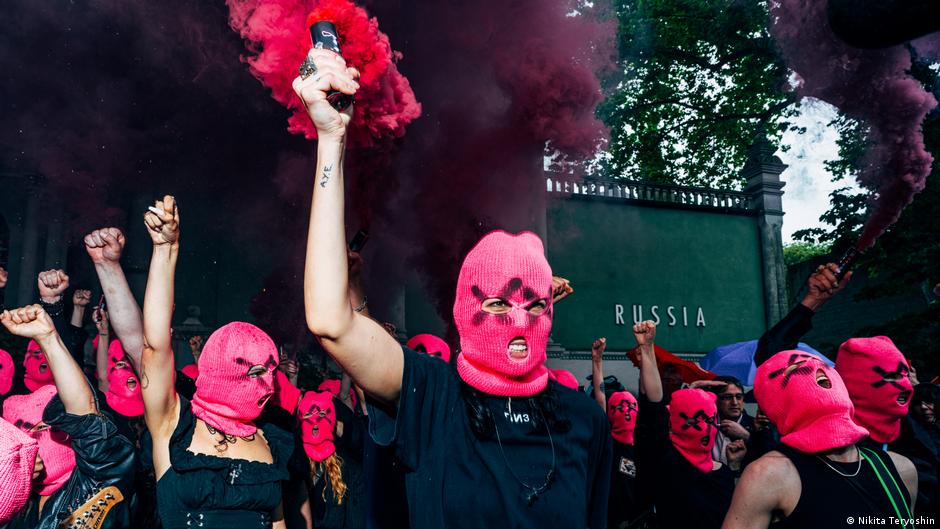
On May 6, feminist punk band Pussy Riot and Ukrainian activist group Femen staged a joint protest in front of the Russian pavilion at the Venice Biennale, demanding that political prisoners with pro-Ukrainian views represent Russia at the international art event.
The activists ignited pink, yellow, and blue smoke flares and chanted slogans such as "Russian art is blood," holding placards reading "Enjoy the show—ignore the war," "Curated by Putin, corpses included," and "Art on display, graves below." Some protesters inscribed these phrases on their bodies, while Ukrainian flags and masks were hung on statues around the pavilion.
"The best citizens of Russia are either imprisoned for anti-regime and pro-Ukrainian actions or killed in prisons, while Europe opens its doors to Putin's officials and propagandists," said Pussy Riot member Nadezhda Tolokonnikova. She argued that Russia’s representation should come from artists imprisoned for their anti-war and pro-Ukrainian stance.
Femen leader Inna Shevchenko added, "Every Russian artwork shown this year stands on an invisible pedestal: Ukrainian blood. This is not in the catalog, but it is the real material sustaining the pavilion."
Market and Sector Implications
Russia's participation marks its first presence at the Venice Biennale since the full-scale invasion of Ukraine began, a move that sparked sharp criticism from the European Union and Ukraine. The European Commission regards Russia's inclusion as a violation of the EU's sanction regulations. Amid the backlash, the pavilion was opened only for invited guests from May 6 to May 8, coinciding with a continuous sound performance titled "Tree Rooted in the Sky." When the Biennale opens to the public on May 9, the pavilion will be closed.
The controversy has led to the exclusion of Russia and Israel from award consideration, prompting the Biennale jury to resign. These developments underscore the complex intersection of geopolitics and cultural events, which have ripple effects on market sentiment and sector rotation in related industries.
The Russian pavilion is operated by Smart Art, a company founded by Ekaterina Vinokurova and Anastasia Karneeva. Notably, Karneeva is the daughter of a retired general and deputy director of the state defense conglomerate Rostec, while Vinokurova is the daughter of Russian Foreign Minister Sergey Lavrov. This connection to state-linked figures adds another layer of scrutiny for investors and analysts monitoring defense sector equities and companies linked to Russian state interests.
The geopolitical tensions and public protests surrounding Russia's cultural representation have broader implications for stock markets. Investors are closely watching shifts in trading volumes of defense stocks, as well as companies with exposure to sanctioned Russian entities. Equity research teams are reevaluating sector allocations, particularly within international art markets, defense contractors, and geopolitical risk-sensitive stocks.
Market participants should consider how ongoing geopolitical disputes and public actions, such as protests at major cultural events, may affect investor sentiment and sector rotation strategies. The intersection of culture, politics, and economics is increasingly influencing asset flows and valuations in global markets.