North Korea Missile Launch Puts Defense and Asia Risk Trades in Focus
South Korea said North Korea fired at least one ballistic missile toward the Sea of Japan, sharpening investor attention on regional security risk.
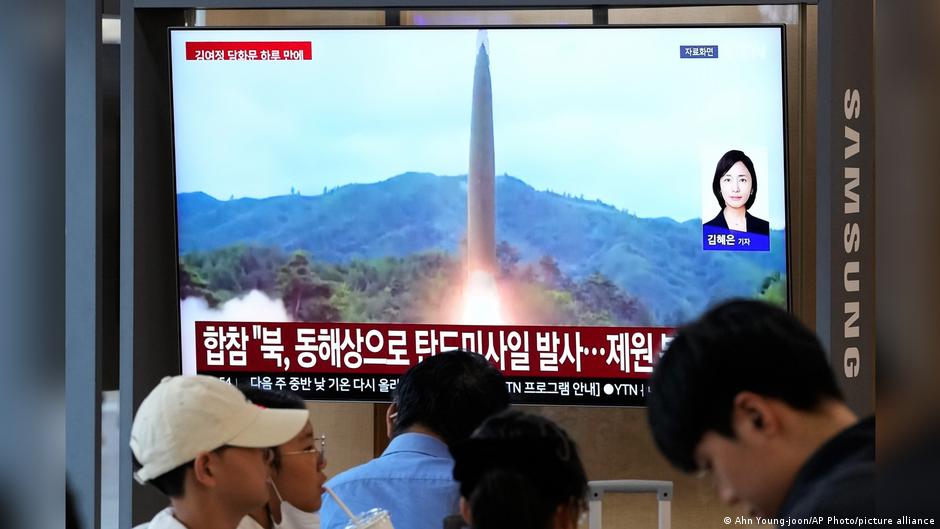
North Korea fired at least one ballistic missile toward the Sea of Japan, South Korea’s military said on Saturday, October 3, adding a fresh geopolitical risk point for investors already watching Asia-Pacific defense exposure, Korean equities and broader risk sentiment tied to the region.
The launch was reported by South Korea’s Joint Chiefs of Staff, which said Seoul, Washington and Tokyo were maintaining a high level of military readiness while closely sharing information on North Korean ballistic missiles. For Wall Street, the immediate market relevance is less about a single launch in isolation than about whether the episode reinforces a pattern of security tension that can influence sector rotation, hedging demand and positioning in companies with exposure to defense, aerospace, semiconductors and Northeast Asian supply chains.
“South Korea, the United States and Japan maintain a high level of combat readiness, while maintaining close information-sharing on North Korean ballistic missiles,” Seoul said in a statement.
The missile report followed a September 21 explosion in the border area between North and South Korea that injured three South Korean service members. Seoul believes the incident was the result of North Korean anti-personnel mines being detonated, AFP reported, citing South Korean military sources. South Korean Defense Minister Kang Shin Chul accused Pyongyang of violating the armistice and announced an intention to take retaliatory measures. The Joint Chiefs of Staff demanded that North Korea apologize.
North Korea rejected the accusation. Kim Yo Jong, the sister of North Korean leader Kim Jong Un, called the South Korean claim “extremely low and dirty,” according to the North’s state agency KCNA.
Defense Shares and Regional Risk Premium
For equity investors, the event places defense contractors and regional security-linked names back on the screen. U.S.-listed defense primes, missile-defense suppliers and aerospace companies often draw attention when tensions rise around the Korean Peninsula, because investors tend to revisit the durability of government defense spending and allied procurement priorities. The same applies to South Korean defense manufacturers and Japanese security-related industrial names, where trading desks may monitor whether local volumes rise around the headline cycle.
The source report does not provide market prices, volume data or company-specific moves. Still, the implications for sector rotation are clear enough for investors to frame the session: geopolitical risk can support defense and security-linked equities while weighing on cyclicals more directly exposed to regional consumer demand, transport flows or investor confidence. In U.S. markets, that usually means traders look first at aerospace and defense exchange-traded products, large-cap defense suppliers and companies tied to surveillance, missile systems and allied military readiness.
Asia-focused equity funds may also see renewed scrutiny. South Korea is central to the global technology supply chain, particularly in memory chips, displays, electronics and advanced manufacturing. Any escalation around the peninsula can prompt investors to reassess risk premiums attached to Korean assets, even when the immediate military event does not disrupt production. That reassessment can show up through currency hedging, demand for liquid regional ETFs, changes in futures positioning and relative performance between defensive and cyclical sectors.
Semiconductors, Autos and Supply Chains
The Korean market’s global importance means Wall Street equity research desks are likely to treat the launch as part of a broader risk dashboard rather than as a standalone thesis-changing event. Semiconductor investors may watch whether geopolitical headlines affect sentiment toward Korean chipmakers and their U.S. customers, suppliers and equipment partners. Auto investors may also monitor any pressure on companies with Korean manufacturing exposure or supplier relationships.
At the same time, analysts typically distinguish between headline risk and operational risk. The Russian-language source article reports a missile launch and heightened military readiness, but it does not report any supply-chain disruption, sanctions decision, plant shutdown or direct commercial impact. That distinction matters for equity research: absent concrete disruption, most company models would not change solely because of this launch. Instead, strategists may adjust the language around geopolitical risk, regional valuation discounts or tactical hedging.
Trading volume is another area to watch, particularly in liquid instruments linked to South Korea, Japan, defense and emerging Asia. Risk events can concentrate activity in index futures, currency-linked products and high-turnover ETFs before single-stock fundamentals are reassessed. For U.S. investors, the relevant question is whether the headline fades quickly or feeds a longer sequence of events following the September border explosion and South Korea’s accusation that the armistice was violated.
Armistice Context Keeps Risk Persistent
The Korean War ended in 1953 with an armistice agreement, not a formal peace treaty. South Korea and North Korea therefore remain formally at war. The two countries are separated by the demilitarized zone, with a demarcation line running through the middle of the mined strip. It remains one of the most fortified and heavily mined borders in the world.
That background is important for markets because the peninsula’s risk premium never fully disappears. It tends to move in waves, rising when missile launches, border incidents or official threats coincide with broader investor sensitivity to geopolitical shocks. Saturday’s launch came after Seoul had already blamed Pyongyang for the September 21 border blast that injured three South Korean troops, making the sequence more significant for analysts tracking escalation signals.
North Korea’s denial of responsibility for the border incident adds another layer of uncertainty. When competing official narratives harden, investors often focus less on the statements themselves and more on the practical response: military readiness, allied coordination, retaliation risk and the possibility of further tests or incidents. Seoul’s statement that South Korea, the United States and Japan are sharing information closely underscores that this is not only a bilateral issue but a regional security matter with implications for U.S. policy and allied defense posture.
For Wall Street, the near-term market impact will depend on follow-through: whether there are additional launches, new military steps from Seoul, Washington or Tokyo, or any signal that the situation is moving beyond familiar cycles of missile testing and diplomatic denunciation. Until then, the most direct equity-market read-through is a renewed focus on defense names, Asia risk hedges and Korean-exposed technology and industrial supply chains.