Kharkiv Drone Strike Puts Ukraine-Exposed Stocks Back in Focus
The overnight attack injured four people and renewed investor attention on defense, energy and regional risk-sensitive equities.
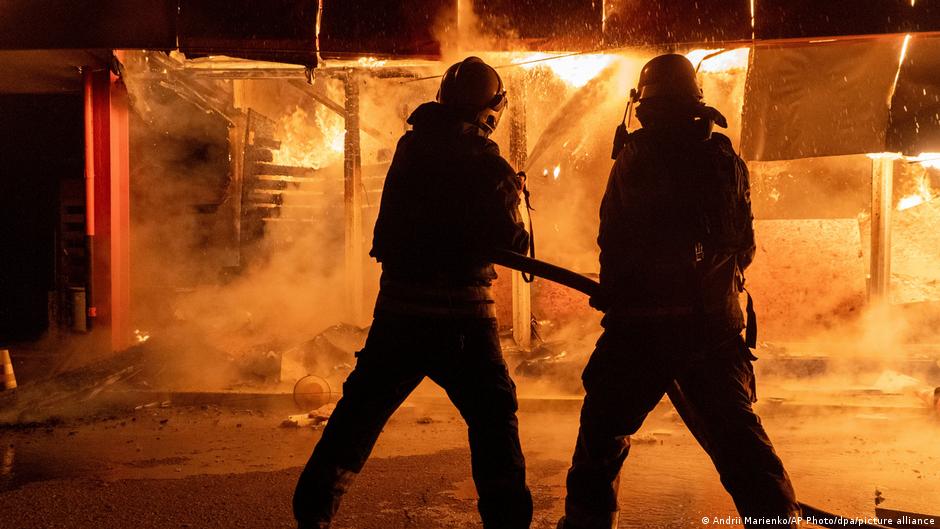
A Russian drone struck a residential building in Kharkiv overnight on Wednesday, October 28, injuring four people, including a four-year-old boy, according to Ukrainian local authorities. The attack also caused fires at residential properties and a two-story industrial building, placing renewed attention on the market risks associated with the continuing war.
For Wall Street, the immediate significance lies less in the direct economic footprint of a single strike than in what the incident signals about the persistence of aerial attacks and the potential for further escalation. Investors tracking Ukraine-exposed companies, European industrial groups and global defense contractors may view the attack as another reminder that geopolitical risk remains embedded in regional valuations.
Oleh Syniehubov, head of the Kharkiv regional military administration, said the overnight attack affected the city’s Osnovianskyi district. A two-story industrial building, a two-story apartment building and a one-story residential house caught fire, he wrote on Telegram.
Syniehubov later said the wounded were women aged 32 and 65, a 56-year-old man and the four-year-old boy. Three of the four required hospitalization.
“A strike on an apartment building. According to available information, people are trapped inside,” Kharkiv Mayor Ihor Terekhov wrote.
Defense and regional risk remain central for investors
The reported strike offers no company-specific financial disclosure, trading-volume data or evidence of damage to a publicly listed enterprise. Its market relevance instead comes through the broader channels Wall Street uses to price the war: defense spending, energy security, commodity transportation, insurance costs and the risk premium attached to European assets.
Defense shares are likely to remain a focus for equity desks because continued drone, missile and guided-bomb attacks reinforce expectations that Ukraine and its partners will require sustained supplies of air-defense systems, interceptors, electronic-warfare equipment and ammunition. Analysts evaluating the sector typically distinguish between political commitments and revenue already reflected in order backlogs, making contract announcements and production capacity more consequential for individual stocks than battlefield reports alone.
The incident may also support continued sector rotation toward companies perceived as beneficiaries of higher security spending, while keeping pressure on businesses with substantial exposure to disrupted transport routes or vulnerable infrastructure. However, the source report provided no figures on share-price moves, turnover or unusual trading volumes, and the attack by itself does not establish a measurable effect on U.S. equity indexes.
Energy and materials traders may watch for any expansion of attacks toward infrastructure with implications for electricity generation, fuel supply or exports. In this case, authorities reported a fire in an industrial building but did not identify the facility, describe its operations or quantify the damage. There was therefore no basis in the initial report for linking the incident to a particular commodity market or listed company.
Broader aerial threat extended beyond Kharkiv
Ukraine’s Air Force separately warned of a possible ballistic-weapons threat from Russia’s Bryansk region toward Kyiv, before later canceling that warning. According to posts on the Air Force’s Telegram channel, attacks involving jet-powered unmanned aerial vehicles and guided aerial bombs continued toward the Kharkiv and Dnipropetrovsk regions, as well as Kyiv and the surrounding region.
The wider pattern matters to investors because simultaneous threats across several regions can increase uncertainty around industrial activity, logistics and infrastructure resilience. For equity research teams, repeated attacks may shape assumptions about reconstruction timelines and capital requirements, particularly for utilities, construction materials, engineering and transportation businesses.
Even so, investors generally require confirmation of physical damage, operational disruption or changes in government procurement before revising company earnings forecasts. The available account documented casualties, fires and continuing aerial threats but did not include estimates of economic losses, production interruptions or changes in military spending.
That distinction is important for trading decisions. Geopolitical headlines can produce short-term interest in defense and energy stocks, but durable revaluation normally depends on subsequent policy decisions, contracts, commodity-price changes or identifiable effects on corporate cash flows. The Kharkiv attack adds to the risk backdrop facing European markets without, on the information reported, providing a direct catalyst for any single Wall Street-listed stock.