Georgia Protest Wave Puts Political Risk Back on Investors’ Radar
Opposition leaders plan a major November 28 rally as Georgia’s Constitutional Court weighs a lawsuit seeking to ban opposition parties.
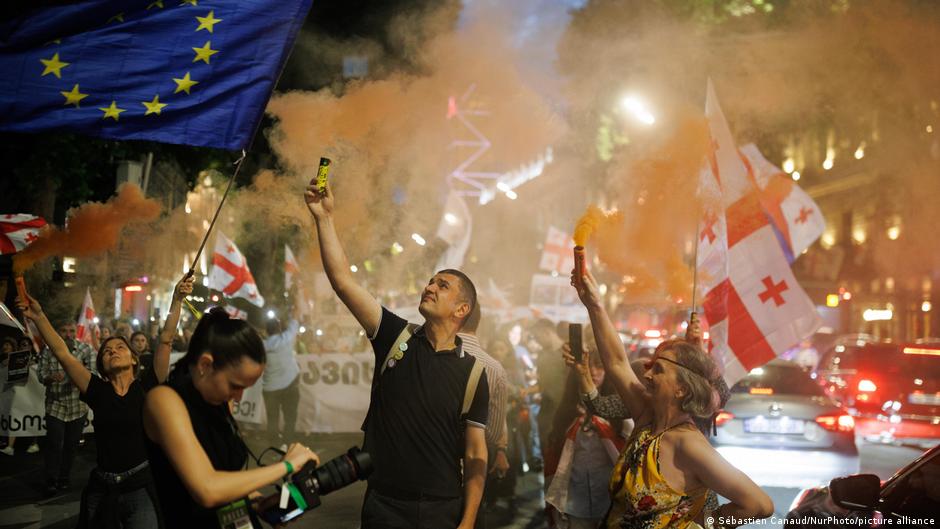
Political risk in Georgia returned to investors’ attention after thousands of demonstrators marched through Tbilisi on Sunday, October 25, while the country’s Constitutional Court considers a lawsuit seeking to ban opposition parties.
The protest, held under the slogan “Georgia Without Ivanishvili,” was organized by opposition figures and civil society representatives against the policies of the ruling Georgian Dream party. Participants marched from Tbilisi State University toward Rustaveli Avenue, carrying Georgian, Ukrainian and European Union flags. A large security presence was also reported.
For Wall Street investors, the immediate market impact is likely to be indirect. The source report provided no share-price moves, trading-volume figures or evidence of a broad selloff linked to the demonstration. Georgia also has limited representation in major US equity benchmarks, leaving portfolio managers to assess the unrest mainly through emerging-market risk, regional financial exposure and companies sensitive to trade, tourism and infrastructure activity in the South Caucasus.
Opposition Sets November 28 as Key Date
Nika Gvaramia, leader of the Coalition for Change, described Sunday’s march as the beginning of a new wave of protests. He said the movement would need a culmination, potentially on November 28—the second anniversary of the start of mass protests in Georgia—or in the days that follow.
“It is important that there are very many of us on the 28th, so that the wind cannot extinguish the fire,” Gvaramia said.
Gigi Tsereteli, leader of European Georgia, also attended the march and said a large and important demonstration was planned for November 28. He argued that Georgia had moved from being a leading candidate on the path toward European integration to an outsider amid what he described as the destruction of democratic institutions and restrictions on political life.
Tsereteli also pointed to the prospect of parties being banned and raised the issue of political prisoners, describing both as significant challenges. The Constitutional Court proceedings are therefore a central event for investors monitoring whether the confrontation remains contained within legal and political institutions or develops into a more disruptive national crisis.
Financials, Tourism and Infrastructure Face the Clearest Read-Through
Equity research teams are likely to focus first on financial companies with direct Georgian operations, even though the most visible listed Georgian banking exposures are not US-listed stocks. Banks are typically sensitive to changes in deposit behavior, credit demand, currency expectations and sovereign-risk perceptions during extended political confrontations. Any assessment of individual names, however, would require company disclosures and market data not contained in the source report.
Other sectors to watch include airlines, hotels and travel platforms with exposure to Georgian tourism; logistics and transportation companies using routes through the South Caucasus; and construction or infrastructure businesses dependent on foreign capital. A prolonged escalation could weigh on business confidence or delay investment decisions, while a peaceful political process would limit the case for a lasting sector rotation.
Trading desks may also examine turnover as closely as price direction. Rising volumes in Georgian-linked securities, regional currencies or sovereign debt would offer stronger evidence of portfolio repositioning than isolated price moves. No such volume data were cited in the report, and there was no indication that Sunday’s march had triggered material trading dislocation.
Long-Running Dispute Over Georgia’s Political Direction
Mass protests began in spring 2024 over Georgia’s “foreign agents” law. They intensified after Georgian Dream won parliamentary elections and developed into a broader crisis in November 2024 when the authorities decided to postpone talks on joining the European Union until 2028.
Previous demonstrations included clashes with police, while authorities used tear gas and water cannons to disperse protesters. That history raises the risk that renewed mass gatherings could produce sharper confrontations, particularly around the planned November 28 action.
For global equity investors, the central research question is whether the latest protest wave changes Georgia’s growth, financing or institutional outlook. Until there is evidence in prices, volumes, corporate guidance or capital flows, the development is best treated as an elevated political-risk signal rather than a confirmed Wall Street trading catalyst. The court process, the authorities’ response and turnout on November 28 will be the next indicators for analysts assessing potential pressure on Georgian assets and regional risk sentiment.